Thursday, January 08, 2015

It's A Thing: Last Christmas

Tangerine Dream. I'm so sorry.
Moffat-Era Tropes: Mildly embarrassing revelations about characters' childhoods. Timey-wimey. Variants on the phrase “timey-wimey” (here, “beardy-weardy” and “dreamy-weamy”). People living in virtual worlds or dreams and being unaware of this fact. Doctor leaves companion and returns when she's an old woman (seriously, that hideous old-person makeup was possibly the worst thing about this episode). “Don't blink” (in this case, close your eyes and don't think about the sleepers). Zombified people marching about until being ordered to go back to bed (see “The Doctor Dances” for the prototype version). Meeting a mythological figure who can't possibly exist. Significant messages appearing on a blackboard or wall. Scottish jokes. References to classic Christmas stories (e.g. “God bless us every one,” or the visual of people soaring over a festive London). MILF. Things coming out of TV screens at people. Referring to a companion's husband by the companion's name (“is there a Mr Clara?”).

It's not a trope, but mad props for including a visual reference to Cocteau's avant-garde film Orphee (Clara standing still as the background recedes behind her, which happens in Cocteau's film when characters journey through the underworld).

A Thing in a Thing: A dream in a dream in a dream in a dream in a dream.....

The Doctor is A: Dream.

The Master Is A: Dream.

Clara Lies About: In a totally foreseen development, Clara and the Doctor find out that they lied to each other last episode.

Reasons Clara Should Drop Danny Like A Hot Potato: Because, although the dream-Danny we meet is a complete gent, he is, as he himself points out, dead, and not going to come back.

Child Count: One (briefly).

The Thick of It: Didn't spot anything, but Red Dwarf would like a word.

It's Actually About: The tangerine on the windowsill at the end of the episode, and the Doctor “waking up” by the volcano from “Dark Water” shortly beforehand, indicate that we're still in a dream (a tangerine dream, presumably), and the fact that Santa Claus turned up in the Tardis at the end of “Death in Heaven” indicates that we have been in a dream for some time. Therefore, a certain percentage of Doctor Who, and potentially all of it, is actually a dream. This, consequently, not only retroactively makes sense of all the daft ideas and continuity problems that have gone before, but effectively insulates the entire series against future snarking. So much for this column, then.

Friday, January 02, 2015

Transnational

Snowpiercer: possibly the most scarily accurate allegory of this decade yet to be filmed. Or, to put it another way, it's Piketty on celluloid.

Movie count for 2015: 1

Wednesday, December 31, 2014

Anthropomorpheous, in the underworld

Orphée: A rewatch-- a surreal film which maps the Orpheus legend onto the tensions and politics of the arts scene in early-Fifties France. Slightly undermined by the ending, which got a little too self-congratulatory, but worth putting up with that for the rest of the movie.

Movie count for 2014: 69

Aptly named

Meet The Feebles: I'd heard this was a scatological and offensive but daringly funny cult movie. I'm fine with scatological and offensive, but I generally prefer it when it comes with an actual plot, and/or a point beyond just trying to be shocking for shocking's sake, neither of which this has.

Movie count for 2014: 68

Pointless Celebrities

Doctor Zhivago: Beautifully shot but ultimately frustrating film about the Russian Revolution, or, more accurately, about the events of the Russian Revolution passing Omar Sharif by as he tries to get it on with Julie Christie. Further enfrustrated by the periodic hints that the supporting characters are much more interesting people involved in much more interesting personal dramas, but enlivened by the fact that the ending has a subtle but definite pro-Communist message that the various awards committees seem to have missed.

Movie count for 2014: 67

Tuesday, December 23, 2014

The Revolution Will Be Novelized

Mockingjay, Part I: Fairly good adaptation of the first half of the novel, with some good messages for teens about propaganda, and about how the enemy of one's enemy is not necessarily one's friend. I was slightly taken out of the narrative because of recognising too many of the actors in it (Queen Margaery had a second career as a photojournalist, who knew?), and the cat pretty much stole every scene it was in, but that was all fairly tolerable.

Movie count for 2014: 66

Sunday, December 14, 2014

Closeted

Skeletons: Surreal British drama-ish thing about two psychic investigators, sort of, who go around exposing the skeletons in people's closets, sort of, and who meet their nemesis when investigating a missing person. Sort of. It's all a bit hard to summarize, but it really is worth seeing.

Movie count for 2014: 65

The House in the Middle

Kiss Me Deadly: Starts out as a conventional film-noir thriller with a distressed blonde flinging herself into the life of a hard-boiled private detective. Eventually turns into an eerie story about nuclear paranoia and the Manhattan Project. Sort of "The Big Sleep" meets "Edge of Darkness", with more sex.

Movie count for 2014: 64

Friday, December 12, 2014

Entertaining June

Brazil: A repeated rewatch (I've lost count of the number of times I've seen it), this one distinguished by having seen it at the BFI with a talk afterwards by Terry Gilliam, and by getting to meet Gilliam afterwards. Film's still brilliant, Gilliam is too.

Movie count for 2014: 63

What's Wrong with the 1970s

Serpico: Biting expose on police corruption, through a biopic of New York policeman Serpico, an innovative and perceptive undercover detective whose honesty and integrity puts him at odds with almost the entire political and law enforcement establishment. It's depressing how little has changed in some ways.

The Candidate: Biting satire on the corrosive influence of politics, as Robert Redford's young lefty activist slowly morphs into a compromised and compromising career politician. You can see where it's going right from the start, but that's sort of the point.

Movie Count for 2014: 62

Cyclo Tron

Tron: A genuinely groundbreaking film on a number of levels, with the technical innovation (the graphics still look amazing over 30 years later) being matched by the playful postmodern referencing of (particularly Soviet) Expressionist film, Christian mythology and video-game imagery. The message is very much of its time (good capitalist/entrepreneur triumphing over bad capitalist/corporation), and there's only one woman in it (to be fair, she's a scientist who's presented as such without any fanfare, and she's far from a passive "prize", freely choosing between two good-looking and intelligent men), but both are easily forgivable.

Tron II: A vastly inferior sequel. There was one major visible technical innovation (the use of a virtual actor, of sorts, to play the young Jeff Bridges-- one step closer to the world of Idoru), but otherwise it was a banal-looking, too-long story with little message other than that the baby boomers think their Generation Y kids are miserable slackers who don't understand them, and which turned the playful virtual world of the first series into a lame collection of well-worn tropes. Michael Sheen was sort of fun to watch though.

Movie count for 2014: 60

Grauniad

Guardians of the Galaxy: Watchable superhero flick; the action scenes got pretty boring and it was half an hour longer than it should have been, but there was some good humour and interesting worldbuilding, and a sort of Firefly-esque self-awareness.

Movie count for 2014: 58

Thursday, December 04, 2014

Live, Die, Repeat

Groundhog Day: Watched as a follow-up to Live, Die, Repeat (below). It's still good; its score on the Bechdel Test is practically negative, but the message is so perfect that I'm willing to forgive it for that.

Movie count for 2014: 57

Two Films Which Shouldn't Be About White Guys

Godzilla: Remake of the much better Japanese original. It wants to be a story about two middle-aged scientists, one Japanese and one American. It winds up being a story about a young white guy. There are also hints that a subplot involving the young white guy's young white wife got cut out to make it even more about him. Meanwhile, all the subtext about nuclear power and global war goes out the window.

Live, Die, Repeat: This one is much better, a sort of cross between Groundhog Day and Pacific Rim. It's also better in that it really is about Emily Blunt, just seen through the eyes of Tom Cruise (even though all the publicity material that I've seen focuses on him and makes it look like a movie about a white guy), that the hero doesn't get the girl but it's completely OK, and that the story really is genuinely interesting.

Movie count for 2014: 56

Reasons to hate Steven Spielberg, sort of.

AI (Artificial Intelligence): One of these bad films with just enough good in them that it keeps me going back over and over them, trying to figure out what the hell the problem was (aside from the sentimentality, and Spielberg once again exploring his abandonment issues). A few thoughts:

1) Too short. Yes, for a movie it's way too long, but it also feels like it's rushing from plot to plot, scene to scene. We never actually see the couple bonding with their new AI son; the woman gives him the imprinting programme, and then practically a scene later we're into the sibling-rivalry scenario when their natural child wakes up from his coma. If it were a 6-part TV series, then there'd be time for the story to breathe, and scenarios to develop.

2) Wrong ending. The story should have ended with the advanced AIs discovering David. It's perfect; we find out what happened to the world, David gets his wish to be a "real boy" (as he'll be the closest thing to one on the planet) and we can end on a high, tempered with the uncertainty of what sort of future he'll have out there. And we'd be spared the creepily Freudian stuff.

3) Too many fridge moments. Gigolo Joe is framed for murder *how*, exactly? Surely the mecha have some sort of Asimov's-three-laws system preventing them from harming a human, and even if not, he could surely upload his memory to the court and demonstrate that he was with Paula Malcolmsen at the time. Why aren't the police tracking their own helicopters? Why does William Hurt leave David alone in the lab for 20 minutes, with predictable consequences? And so on.

4) Doesn't age well. It was first written in the 1970s, and it doesn't seem like it was updated much when it was filmed in the late 1990s: no mobiles, no Google, a family in which the wife stays at home all day doing, as far as I could see, pretty much nothing.

On the other hand, hey, cool practical and digital effects, and I want one of those teddy bear androids.

Movie count for 2014: 54

Vengeance Is Theirs

Sympathy for Mr Vengeance: Riveting tragedy about how good intentions can lead to catastrophic disasters, and how it can sometimes be hard to determine who the victims are.

Sympathy for Lady Vengeance: Follow-up to the latter, using many of the same themes and some of the same actors. Poses uncomfortable questions about culpability and the social/emotional cost of pursuing revenge.

Movie count for 2014: 50

World Gone Mad

Despicable Me: Kids' film about a villain who learns the redeeming power of love when circumstances throw him together with three orphan girls: cute, but with a bit of a Brothers' Grimm/Roald Dahl subversive edge, and the child characters are believable.

In Bruges: A rewatch. Two Irish gangsters hole up in a Belgian city over Christmas after an assassination goes horribly wrong. Bruges is lovely but cold (in all senses of the word) and the story tragic. It's about the senselessness of it all, really.

Seven Psychopaths: Postmodern film about the writing of a movie, which becomes a movie; sort of an anarchic cross between *The Player* and *Natural Born Killers*.

Movie count for 2014: 53

Wednesday, November 26, 2014

It's A Thing: Death In Heaven

There's only one thing harshing my squee
about this episode, and it's this.


Moffat-Era Tropes: Everything from last week, plus: New-look UNIT with Osgood and the She-Brigadier, “bowties are cool”, the Doctor coming up with an insulting nickname for someone, “Permission to squee!”. There's a belated attempt to rectify the fact that Brigadier Lethbridge-Stewart never appeared in the new series proper.

A Thing in a Thing: An army of Cybermen in graveyards.

The Doctor is A: President of Earth (that's actually some pretty neat lateral thinking on UNIT's part). Also a blood-soaked old general, but then again Danny's got issues (see last episode).

The Master Is A: Queen of Evil.

Clara Lies About: Being the Doctor (though the credits apparently believe her). She and the Doctor lie like rugs to each other in the cafe scene.

Reasons Clara Should Drop Danny Like A Hot Potato: Because even as a cybernised corpse, he's still passive-aggressive, self-obsessed and dealing with some pretty bad issues-- including threatening to shoot her before losing all human emotions.

Child Count: One (undead).

The Thick of It: Missy finally kills off Chris Addison.

It's Actually About: How you can never be sure of anything, except unconditional love.

It's A Thing: Dark Water

Moffat-Era Tropes: Troughton-era references. Dead people's personalities surviving as computer programmes. Monsters being kept in fluid-filled glass tanks in a facility of some sort. Companion's boyfriend dies and the Doctor has something to do with resurrecting them. The companion's timeline being mysteriously intertwined with someone else's. Scottish jokes. As numerous people on the Internet pointed out, Missy is yet another iteration of the mysterious, slightly antagonistic older woman with a flirtatious relationship with the Doctor (e.g. River Song). The Doctor getting unexpectedly snogged. “Doctor who?” There's an inside joke when we learn that the Doctor keeps a copy of “The Time-Traveler's Wife” (which Moffat is frequently accused of using as a source rather too often, not least on this blog) in the Tardis.

A Thing in a Thing: An army of Cybermen in St Paul's Cathedral.

The Doctor is A: bit slow on the uptake this week, as he doesn't figure out who the Master is until she flat-out tells him.

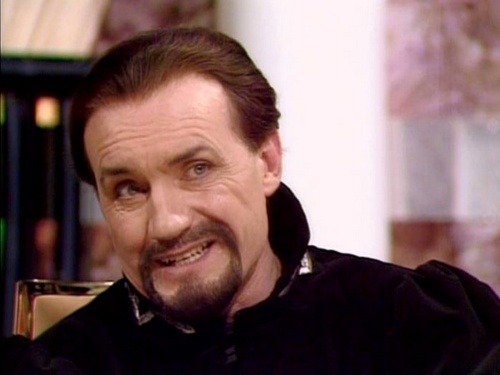
Seriously, she's totally the girl version of this guy.
The Master Is A: Woman. But most of the audience had figured that out.

Clara Lies About: Nothing. There's something important she hasn't told Danny yet, but the audience don't find out what it is either.

Reasons Clara Should Drop Danny Like A Hot Potato: Because even death is no barrier to his passive-aggression and self-obsession (it also turns out that the thing he's been blaming the officers for is in fact something he screwed up himself-- namely, he sprayed a room with gunfire without checking what was in it and shot a child-- which shows a distinct inability to take responsibility for his own actions).

Child Count: One (dead).

The Thick of It: The Doctor's psychic paper announces him to be a government inspector: “Why is there all this swearing?” Doctor Chang asks, perusing it, and the Doctor answers, “I've got a lot of internalised anger.” Chris Addison is also back.

It's Actually About: The Kubler-Ross stages of grief.

Tuesday, November 25, 2014

It's A Thing: In the Forest of the Night

Moffat-Era Tropes: Child-focused story, particularly one revolving around some unusually special little girl; fetishization of motherhood; trees; a thing that appears to be malevolent turning out to be benign. Little glowing tree-spirit things which are clearly the same ones seen in “The Doctor, the Widow and the Wardrobe”. Happy ending that makes no damn sense whatsoever. There's a slightly jarring call-back to the Davies Era in the montage of international news broadcasts (which suggest that everyplace everywhere is affected by the forests, a fact which is immediately forgotten).

A Thing in a Thing: A forest in central London.

The Doctor is A: Scotsman. But why do none of the kids recognise him as the school caretaker?

The Master Is A: TV viewer. Presumably Apple TV.

Clara Lies About: Calling the Doctor instead of the school. This week Danny's the one to find out about her Big Lie in “Mummy on the Orient Express”, and the results are predictable. It also turns out that she just tells the class they're “Gifted and Talented” to make them feel better, which speaks volumes about her wanting Courtney to think she's “special” in “Kill the Moon”.

Reasons Clara Should Drop Danny Like A Hot Potato: Seriously, he's offered the chance to see the Earth from space being hit by a solar flare, no strings attached, and he turns it down like a kid in a sulk, saying he doesn't want to see anything new because “I was a soldier” (trust him to bring that up again)? Unless Clara wants to spend the rest of her life never going out, she'd better end this now.

Child Count: 8 (that's a pretty tiny class by anybody's standards, let alone those of modern hyperinflated student-to-teacher ratios). Possibly 9 if Mabh's sister counts, but it's hard to tell how old she is.

The Thick(et) of It: The Doctor tones the Mr Nasty act down a bit this week, probably because of the children present.

Where is Max when you need him?
It's Actually About: Something narratively interesting happening, and then absolutely nothing that follows making sense. Why is central London entirely deserted except for one school group and a disappearing security guard? Why was nobody, apparently, awake at the point at which the forest appeared? Why aren't the children's phones ringing themselves flat with calls from anxious parents, why is Mabh's mother the only one concerned enough to take any kind of initiative to find her daughter, and why doesn't Clara ring the school (indeed, why doesn't the school ring either Clara or Danny)? How does Year Eight get from Kensington to Trafalgar Square in next to no time? What idiot at COBRA thought burning the trees was a good idea (since it would clearly cause massive damage to very expensive property if it worked), and why do the emergency crew not react to the sight of two civilians walking out of the forest with cries of “bloody hell, stop the burning, we thought the area was deserted, now then, miss, tell us how many more people are in there?” Why are international relief efforts not being coordinated? Where, indeed, are UNIT, Torchwood, and all the other usual suspects? Why do Mabh's mother and her neighbour react so calmly to the revelation that the street is covered in trees? How does the Doctor not know how ice ages work? Why do zoo-habituated wolves and tigers immediately go on the attack, rather than finding a safe place to hole up till they can get the lie of the land and investigate? Who left a set of beach chairs out in central London? How do planes land? Since the sea is now also covered with vegetation, what's happened to the boats? Why does Clara think that dying is preferable to being orphaned, and who does she think she is, making that decision on behalf of the whole class and Danny? How does a phone call to everyone on Earth from a single schoolchild result in mass global consensus as to the correct course of action (why can't we get Mabh to advise on Mideast peace)? Why does nobody consider that the solar flare would knock out every single communications satellite, plus kill off everyone on the international space station? Why the strange anti-medication message-- yes, there's controversy about diagnosing and medicating some childhood-onset disorders, but suggesting that every child with psychotic symptoms is just talking to the tree-fairies is a little regressive. And was Mabh's sister hiding behind a bush the whole time? There's a great story to be told about a forest appearing in London overnight, but this really isn't it.